Friday, June 29, 2007

NECC: Wikis in the Classroom, Web 2 and other presentations

I've been uploading the presentations that I shared at NECC -- I don' t have all of the audio files, yet, but here are the slideshares:

Wikis in Education with Adam Frey


Women of Web 2
I shared some cool new tools in Web 2 (including some from other bloggers at the blogger cafe that day!)


Flat Classroom Project: Online Learning with a Web 2 Spin


This was a poster session -- Here was our poster (designed by my sister)
This album is powered by BubbleShare - Add to my blog

And the handout (in pdf format) explaining the basics of the Flat Classroom and Horizon Projects in a comparison grid. If you want to know what we did, this is your handout.

Elluminate/ Crick Software Presentations
I spent some time with these companies and shared a presentation I call Think Global/ Teach Global (redone in Presentation 2.0 style, of course -- still getting there.)
**It didn't upload correctly to slideshare so it will come your way later.**

Some other Must see NECC resources:
  • NECC Live Webcasts -- Julie and I are on this show which will be published at some point on this page, meanwhile, one webcast is already up.
  • Official NECC Podcasts - Adam Frey and I spent some time talking about Wikis but there are some other great podcasts that are already available here. Ours will be posted here as well.
It was a great conference and I have to post at least 4 more sessions that were in my notes (b/c no laptop plug was available) -- but that will have to be later.

Meanwhile, if I see a bit distant, I am tired, but also my grandmother is not doing well and expected to die at any moment, I have to be with my family.

I treasure the experience as NECC as truly a highlight of my educational career. The blogosphere is full of great people with a variety of perspectives but who really care about kids... and that is what we are about...shaping student lives.

So many ask me, "what's next" and indeed many work hard to "score" so they can get out of the classroom. I am called to the classroom, I love to teach and indeed any move away from the classroom would be a demotion for me. I love to teach!

Thank you all for being such a great part of my NECC experience, whether you are a reader, commenter, or edublogger.

tag: , , , , ,

Read more »

Wednesday, June 27, 2007

{Google Desktop} ε Linux

Announcement
June 27, 2007

(Google Desktop now on Linux)

Google Desktop hit the operating system trifecta today with the release of a version of Google Desktop™ for Linux. Now available on Linux, Mac OS X and Windows, the Google Desktop application allows users of every major operating system to search their desktop and the web as quickly, easily and comprehensively as they search the web with Google.

Major features of Google Desktop for Linux (beta) include:

  • Comprehensive Indexing – Users can search the full text of virtually all their computer’s content, including text, PDF, PS, source code, HTML files, email from Thunderbird, OpenOffice.org documents, Man and Info pages, folders, images, and music. Google Desktop for Linux can even find previous versions of files or recover those that have been accidentally deleted.
  • Quick Search Box – The Quick Search Box is the fastest way to do web and desktop searches. Hitting the command key twice calls it up, instantly displaying results as users type.
  • Gmail and Web History Search – Not everything users are looking for resides on their computer. Google Desktop for Linux makes it easy for users to simultaneously search their Gmail™ webmail, web search history and the web at large. And because their index is stored locally on their own computer, users can even access their Gmail and web history while they’re offline.

With this release, Google Desktop joins the Picasa™, Google Earth™ and Google Toolbar for Firefox™ applications among Google’s offerings for Linux. In addition to creating products that run on Linux, Google supports the Linux community in a variety of ways, such as releasing open source code, running the Summer of Code™ and hosting tens of thousands of open source projects on Google Code™ (code.google.com).

Google Desktop for Linux (beta) was developed by Google’s Beijing engineering team, and is available in English, French, Italian, German, Spanish, Dutch, Chinese (simplified and traditional), Japanese, Korean, and Portuguese. It runs on Debian 4.0, Fedora Core 6, Ubuntu 6.10, SUSE 10.1, and Red Flag 5, and can be downloaded for free at desktop.google.com.

###

Google, Google Desktop, Google Code, Google Earth, Google Toolbar for Firefox, Gmail, Picasa and Summer of Code are trademarks of Google Inc. All other company and product names may be trademarks of their respective companies.

Read more »

Google Pilots Program To Expand the Universe of Gadgets

Announcement
June 27, 2007

Today, Google announced a new pilot initiative called Google Gadget Ventures aimed at bootstrapping an economic ecosystem around gadgets. Since the launch of Google Gadgets more than a year ago, we’ve seen an increasing opportunity for individuals and companies to build successful businesses around this technology and are piloting this program to help support additional growth.

Google Gadget Ventures will offer third-party gadget development and gadget-related businesses two types of funding:

  • Grants of $5,000 to developers who’ve built gadgets in our directory that already receive at least 250,000 weekly page views. To apply, qualified Gadget developers will be asked to submit a one-page proposal.
  • Seed investments of $100,000 to previous Google Gadget Ventures grant recipients who’d like to build a business around the Google Gadgets platform. Qualified developers will be asked to submit a business plan.

The developer community is an extremely important part of our development ecosystem. Our hope for Google Gadget Ventures is to enable developers to grow and diversify the universe of gadgets in a profitable and sustainable way. Ultimately this will result in a wider variety of engaging and useful online content, which is a win for our users. For more information, please see www.google.com/gadgetventures.

Read more »

Tuesday, June 26, 2007

Live Blogging this morning's Keynote Panel

I am packing, tweaking my presentations for tomorrow at noon and 1:30, IMing with John Pederson and figuring out how I'm going to check out at 7 and be at a breakfast meeting at 7.


Wifi was nonexistent in the morning keynote, but I took these notes and what to share them with you. It was phenomenal!


A lot of discussion of going global and the need for creativity and innovation. Outstanding teacher and leader awards. They are recognizing Carole Colburn - Howell public schools in Howell, Michigan. Does a lot of community service with her students -- project skill (they do the "thank you speeches" on video -- they are edited and very good -- this a great idea.)

What it would be like to be a senior citizen in today's world. Culminating event was to have local senior citizens into the classroom. Her students serve as their mentors. (Great idea -- have the grandparents organization -- teach the grandparents!)

Charlene Chausis

2007 Outstanding Leader -- Job is professional development -- to lead faculty and staff in technology -- she gets them there. Work with teachers in summer school -- live from Ancient greece -- podcasts as if they were recording from 1756 BC -- showcased if it was good enough -- they wanted to work and do it so much -- get kids so excited about that sort of project. Wrote scripts to start with -- but when they knew that they had an audience and that it was authentic they got very excited.

ISTE has info need if you are trying to build the technology plan at your school. They are using the New NETS for students.

These two women are amazing.

Great idea --- lifelong learning - senior citizens come in and the students mentor them.

Need to book Charlene and Carole for W"OW2

Keynote - Futurist Andrew Zolli - Lead discussions about the emerging creative class and what they demand of schools - what they offer society. How education and cultivate creativity and innovation worldwide.

If you put your e-mail in front of educators they will e-mail you during your presentation. Great images.

Electronic bath duck -- funny. One use only.

What it takes to unlock the creative potential that lies within all of us.

Great group of people - educator on edge, analyst, creative director - new innovative ideas, artist and choreographer reinventing modern dance. Each one make a 2-3 minute thought starter for all of us. Who they are and what their backgrounds are.

Mary Cullinane - Philadelphia School of the Future Project - a lot of research on what it take sto build

Dr. Francis Pedro - how countries do competitively around the world in the realm of education. Onling research in relation to learning.

Michael McCaulie- creative solutions for organizations, Oprah, Target

Elizabeth Streb - choreographer -- won McCarthur genius award in 1997. Ongoing passion for science and physics only choreographer physicist in the world.

Mary Cullinane

Past 4 years -- what if a company like microsoft wanted to create the school of the future, what would it look like. Experts to help think about that question. Sept 2006 was the attempt, not an answer -- fundamentally questioning the norm. How can we create an environment that can have "artists of learning"

  1. Learning First, technology later (not even 2nd)
  2. Really focus on the concept and power of language. The ways we can use language to create a creative environment -- are we modeling and doing that. The principal is called the chief learner not the principal.
  3. Be comfortable not knowing

These are the three principles that guide the school of the future. The opportunity for creativity in the age of accountability. How can they exist together?

Dr. Francis Pedro

From France

Main questions asking the innovation potential for countries.

  • How innovative are countries? (The 30 richest countries in the world.)
    • Can we compare the innovation potential.
    • Use of educational technology as a window of opportunity.
    • Two dots for each coutnrie -- blue dot the % of 15 year old that use a computer connected to the Internet on a regular basis at their home -- In the US it above 80% but Canada -- 90%
    • Percentage of the same people who use the computer connected to the Internet while at high school -- Only just above 25% for kids who use computers at school frequently -- do not use educational technology at school is very low for 15 year olds.
  • Does it really matter to use a computer
    • Every 3 years to study competities math, science -- found it is extremely important to have access to a computer. Green bars show the percentage of scores that people who have a computer at home have over those who do not have access to a computer.
    • How much is associated with having a computer in the school. It is highly correlated -- 70 percentage points -- US -- you will see that we are in the top list -- in our case -- having a computer at school really pays a lot -- 70 points -- computer in high school pays a lot.
  • What is more important?
    • School or home?
    • If we compare -- math scores -- the more computers used in schools math doesn't mean they are getting better.
    • Home use is highly correlated with math scored. Why?
  • Francesc.Pedro@oecd.org

Michael McCaulie (sp of name?)

Seek out your cathedrals. You have the potential to have a very positive impact on the public. So, always think of that higher purpose. You can have a positive impact. It becomes much more important then. You are having a positive impact. Higher purpose.

Intangiables that we have to sell and produce --have to have a deep faith in the concept in the technology and the team.

Elizabeth Streb

Pay attention to what you notice and what you are interested in -- action and movement -- how make and put her life around movement. Humans could fly -- believed in an impossible silly thing -- how long do you have to stay in the air -- she could fly and that we could if we wanted to. -- Invented a place in New York called Slam -- Where to peple want to go to . Alchemy that allows them to go there.

We find our place in the jumping joyous jumping of life.

Invited a bunch of contraptions -- draw and script out what might be possible. Embrace failure and not knowing -- if you link up with the right structural engineer you can fily -

Ask seeminly unanswerable questions -- break the rules -- get two bodies to occupy the same space at the same time - name a move you are unilling to do -- move so fast you stand still. What is space what is time/ I'm going to fall up -- spend four days to figure out how to do that. Overhead view -- Cement blogs swinging over head. On some level it was a true story.

Richoche -- such cool things -- link to the video -- what is methodology and how can we learn. How can we agree to not know. Discovery is a process of having a good clean question an d

www.strebusa.org - So cool!

The questions -- from Andrew Zotti

The nature of place.

Mary - create a place in which failure was an option -- kids and educators feel safe to fail -- that was one of the hardest things to create because all of the pressures we have for that word not to be uttered.

2nd element - the concept of ad hoc gathering places -- we need to create spaces -- God forbid kids gather -- we want to create places that kids can gather -- focused a lot in the building where kids can gather and socialize -- they are really not there for algebra -- they are there to be with one another.

Elizabeth - physical place -- Question the difference between public and private - chose a space -- chose a big garage -- all great genres like chemistry explosions and rock roll invented -- people who do things who mess stuff up. Extreme movement gathers people together and has the potential for transformative change. Work at the same time -- circus people - flying trapese -- dancers -- 200 kids a week -- mix up in the most perfect thing you could imagine. Popcorn and cotton candy important.

Michael - Applied arts can be a very dirty business, you have to get your hands dirty and fall down. Conference rooms aren't so creative -- garage is a wonderful metaphor for the creative process.

To get people creative in business -- you can be anywhere and the flow state happens -- take people out, bring outsiders in, bring in a singer. Mix it up a little bit. I will take people up and bring new people in. Fall down, act stupid, make mistakes to get them comfortable -- eVERY DAY IS DIFFERENT.

Elizabeth -- Allow complete sovereignty -- they can do whatever they want. When kids come together - scream and play as they want and then class begins. She doesn't have a petri dish like we have.

Francis - Fundamentals of creativity -

Innovation in different sectors including education - health, science, biotech -- theory -- the theory of the four ?

Result of the action 4 pumps for educational innovation

  1. Our ability to include doers and users in the process of germinating innovation. We should enlarge our concept of users of educational innovation and include learners in that process.
  2. Our ability to network
  3. Modularity -- Being part of the system but acting autonomously.
  4. Technology - Something that is unique -- we miss the connection between educaitonal technology, science, and research. Teachers see themselves as artisans. What is the place we assign to research?

We have the ability to act autonomously and allow innovation (which doesn't describe education.)

Zotti -- Everyone is talking about risk and empowerment of the individual and courage.

Mary - Challenge that they saw -- could you imagine our public schools if innovation was swimming downstream how much faster we could go. Except in our schools, these types of thinking we are constantly swimming upstream -- when you do you get very very tired. Create an environment where lessened some of the bureaucratic requirements but still do in a framework where others feel that they could do that too. Microsoft didn't give money but gave human capital and gave people. Trying to live within the constraints but push the edge.

Michael - Big brands and big corporations thirsting for innovation -- if schools would adopt that mindset.

Type of the project that -- F2F marketing -- new trend -- traditional ad spending goes down -- interface with the public. National tour with target stores -- rennovating their pharmacies -- health and wellness centers.

Mile 20 -- Rocky Theme blaring from his car and finished the race -- a concert experience at mile 20 for every marathon runner at mile 20 in every country a long tunnel that blares motivational music -- the rocky theme that marathon runners run through-- most motivational experience staged it in LA -- 22,000 runners -- When staged it -- it became a heroes welcome -- most of all the paraplegics -- weren't prepared for it -- it was joyful -- Amazing -- targeting paraplegic runners -- he had no legs -- pumped is way through 26 miles on a skateboard. Everyone is spellbound - the most inspirational thing -- amazing inspiration -- Rocky Them -- amazing -- experiencing -- have a profound impact. You're not doing a promotion you are making a mark on someone's life. WE have that opportunity every single DAY -- So amazing -- put it everywhere in marathons.

Francis - Understanding of the brain

We think learning is mostly about educating our brains but it isn't -- a series of reports - invites us to read -- demystify some of the myths that we have. When do you start learning foreign languages. Should be elemetary education -- research that foreign languages as soon as possible. Need to start very young! As many languages as possible.

The idea that some educational systems especially new ones people are seeing the need to separate girls from boys think that brains work differently. No evidence based on research on that -- we have to research a bit more if we are going to separate things -- that is not a difference in brain.

Zotti - Cognitive neuroscience -- His graduate work in that. Phenomenal experiment that was done -- babies don't know where they are born and the myriad of languages that we speak have different structures and different sounds and not all languages - English b and p -- small differences -- Thai -- have 5 letters between b and p - microphones on babies -- babies cannot tell you that they can hear the differences. Exposed to new sounds their heart rates go up and they relax -- babies can hear the differences. Besides the time the research subjects 7 years lost 80% of the ability to hear the difference. And by 12 lost all of the difference. Decided to call this ability to respond the "hyper sensitive sucking reflex" - scientific data supports that children should hear it at a young age.

Mary - Microsoft

Individuals are self critical and it is expected. How can I get better?

Had time to think. Encouraged to think -- got their own office, had gathering spaces. Thinking and doing something were the same thing -- it is not that way in education.

Elizabeth Asked -- were they private or open source offices? Mary Said - definitely not. Laughed hilariously and gave a high five.

Mary - "bills office is just like mine except there was smarter stuff going on in it" -- they all have the same type of office.

A resource -- book tool that you wish everyone know-

Michael - whole new Mind by Daniel Pink, Dream Society. Excellent.

Francis - Go to www.oecd.org - Next week report understanding the Brain -- new insights what science says about emotions, language, and learning


tag: , , , , , , , ,

Read more »

Getting ready for the live NECC supershow

We're over at edtechtalk.com and in the chat room (click "chat") and to listen to it, click Listen to get the channels to listen. We will be streaming in just a moment.

We are also streaming live into Second Life (for the first time ever) -- Eduisland II 68, 107, 22 -- you can listen live there -- so cool. Also some people from here in the lounge are going into the show as well. So cool.

So, join us here, if you have questions, let us know -- we have a lot of really cool people here.

tag: , , ,

Read more »

Google Docs & Spreadsheets matures with a fresh new face

Announcement
June 27, 2007

When you log in to Google Docs & Spreadsheets today, you might be in for a bit of a surprise: we’ve completed a pretty significant redesign. Since we launched Google Docs & Spreadsheets less than a year ago, we’ve made dozens of updates to enable better collaboration. As more and more documents accumulated, users asked for an even easier way to manage them. With this latest refresh, you’ll see that we have been listening to feedback and spending time thinking about the best ways to stay organized.

Some highlights of the clean new look:

  • Sidebar with folders: For those who used tags, all your tags have been converted into folders, and you can now drag and drop your documents into any folder. Just like tags, docs can live in multiple folders.
  • Documents sorted by collaborator: Sometimes you can’t think of the title or even the content of a document, but you remember whom you shared it with or who shared it with you. To make sorting easier, we’ve added new "created by me" and "shared with…" folders.
  • Better search: With autocomplete, all relevant documents, folders, and collaborators are displayed as soon as you begin typing your search query.

The redesign also includes new icons, chronological sorting, and an easier way to save documents in alternate formats.

These features and other improvements are now available to anybody using Google Docs & Spreadsheets at docs.google.com or through Google Apps

Read more »

Introducing Google Earth Outreach

New initiative helps nonprofit organizations around the world leverage the power of Google Earth to advocate, educate; new Global Awareness layers from Global Heritage Fund, Earthwatch Institute, TransFair USA

MOUNTAIN VIEW, Calif. (June 26, 2007) – Google (NASDAQ: GOOG) today announced the launch of Google Earth Outreach, a new program designed to help nonprofit organizations around the world leverage the power of Google Earth to illustrate and advocate for the important work that they do.

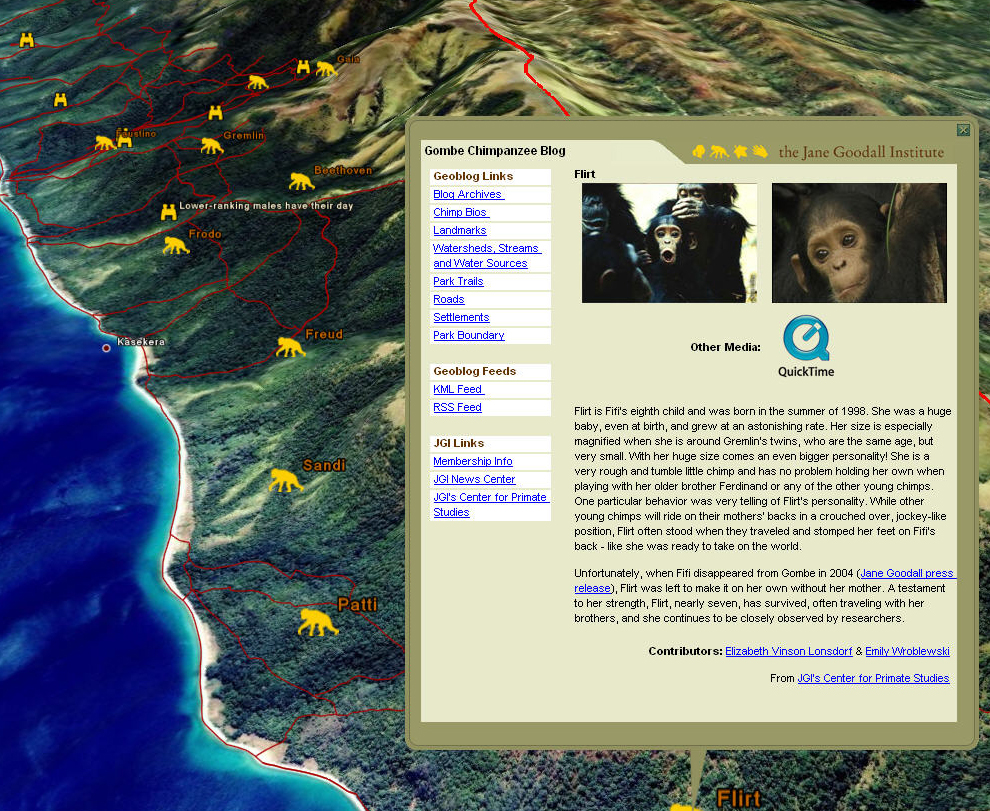
The announcement was made at Google’s New York City office by Elliot Schrage, Google Vice President for Global Communications & Public Affairs, and John Hanke, Director of Google Earth & Maps. Pilot Outreach partners including Jane Goodall, Founder, the Jane Goodall Institute; Kathy Bushkin Calvin, Executive Vice President, United Nations Foundation; and Edward Wilson, President and CEO, Earthwatch, were also on hand to discuss how their organizations are using Google Earth to tell effective and compelling stories about their work.

Google Earth Outreach enables any organization to quickly and easily get the resources it needs to create compelling stories through Google Earth layers. The program includes comprehensive online guides, video tutorials, and case studies about using Google Earth specifically targeted to the needs of nonprofit organizations. In addition, there are online forums connecting new participants to Global Awareness partners and experienced programmers who can assist in developing Keyhole Markup Language (KML) layers for Google Earth. These forums, actively moderated by Google Earth Outreach staff, serve to foster discussion and cooperation among organizations and the broader Google Earth community.

Organizations can also now apply online for Google Earth Pro grants (a $400 value); grantees will receive additional technical support from Google. Participating organizations may be highlighted in the Google Earth Outreach Showcase, an online gallery of the most compelling new layers, and a subset of those will be featured in the Global Awareness folder in Google Earth on a rotating basis. More details about Google Earth Outreach are available at earth.google.com/outreach/.

"Google’s mission is all about making information more accessible and useful," said Elliot Schrage, Google Vice President of Global Communications & Public Affairs. "With programs like Google Earth Outreach, we seek to help create a ‘marketplace of ideas’ in the growing not-for-profit sector that rivals and complements what we offer commercial enterprises. In a very practical way, Google Earth Outreach demonstrates that technology can inspire action by bringin seemingly distant problems closer to home."

"Our goal with Google Earth Outreach is to help public service organizations worldwide leverage our mapping technology to further their goals by providing tailored technical guidance and grants," said John Hanke, Director of Google Earth & Maps. "Now any organization can quickly and easily annotate Google Earth with pictures, video and information to tell visual, compelling stories of the work they do to over 200 million Google Earth users."

"Only if we understand can we care. Only if we care will we help. With Google Earth Outreach, more people have the chance to see, to care, and then to act," said Jane Goodall, PhD, DBE Founder, the Jane Goodall Institute, UN Messenger of Peace.

"Google Earth represents a whole new way for us to connect with the world," explains Ed Wilson, President and CEO at Earthwatch. "Not only can we inform people about key environmental issues facing the world today, but we can give them the opportunity to get directly involved. From our NGO and corporate partners to our dedicated researchers and volunteers, Google Earth provides us all with a centralized tool to communicate our mission--and maximize our impact."

As part of the announcement John Hanke also introduced three new Global Awareness layers for Google Earth:

  • Global Heritage Fund (GHF) – The GHF Global Awareness layer explores cultural heritage sites around the world that GHF is working to preserve for future generations. From ancient Mayan Mirador pyramids buried in Guatemalan forests threatened by clear cutting to the crumbling Lijiang Ancient Town in China, GHF takes users to these endangered archaeological treasures of human civilization and details the efforts to save them in partnership with local governments and resources.
  • Earthwatch Expeditions – The Earthwatch Global Awareness layer enables users to virtually visit more than 100 volunteer Earthwatch expeditions in Google Earth— from recording the activities of lemurs in Madagascar to determining the impact of climate change on grey whale populations in Mexico and Canada. Enthusiasts and would-be volunteers can explore scientific field research projects in progress around the world and learn how they can help collect field data in the areas of rainforest ecology, wildlife conservation, marine science, archaeology, and more.
  • Fair Trade Certified – The TransFair USA layer introduces users to the over 70 Fair Trade Co-ops located throughout Latin America, Asia and Africa. Fair trade is an innovative market-based approach to sustainable development that helps family farmers in developing countries gain direct access to markets and develop the business capacity necessary to compete in the global marketplace.

About Google Earth

Google Earth combines satellite imagery, maps and the power of Google’s search service to make the world’s geographic information easily accessible and useful. There have been over 200 million unique downloads of Google Earth since the product’s launch in June, 2005. Google Earth can be downloaded for free at earth.google.com.

About Google Inc.

Google’s innovative search technologies connect millions of people around the world with information every day. Founded in 1998 by Stanford Ph.D. students Larry Page and Sergey Brin, Google today is a top web property in all major global markets. Google’s targeted advertising program provides businesses of all sizes with measurable results, while enhancing the overall web experience for users. Google is headquartered in Silicon Valley with offices throughout the Americas, Europe and Asia. For more information, visit www.google.com.

Media Contacts:

Megan Quinn
Google Inc.
1.650.930.3555
meganq@google.com

Kate Hurowitz
Google Inc.
1.650.930.3555
khurowitz@google.com

###

Google, Keyhole and Google Earth are trademarks of Google Inc. in the United States and/or other countries. All other company and product names may be trademarks of respective companies with which they are associated.

Read more »